 AI Education Platform
OpenAI Releases GPT-5.4: The First AI Model to Beat Humans at Using a Computer
OpenAI released GPT-5.4 on March 5, 2026 — the first general-purpose AI model with native computer-use capabilities that surpass human performance, a 1M token context window, and 33% fewer hallucinations.
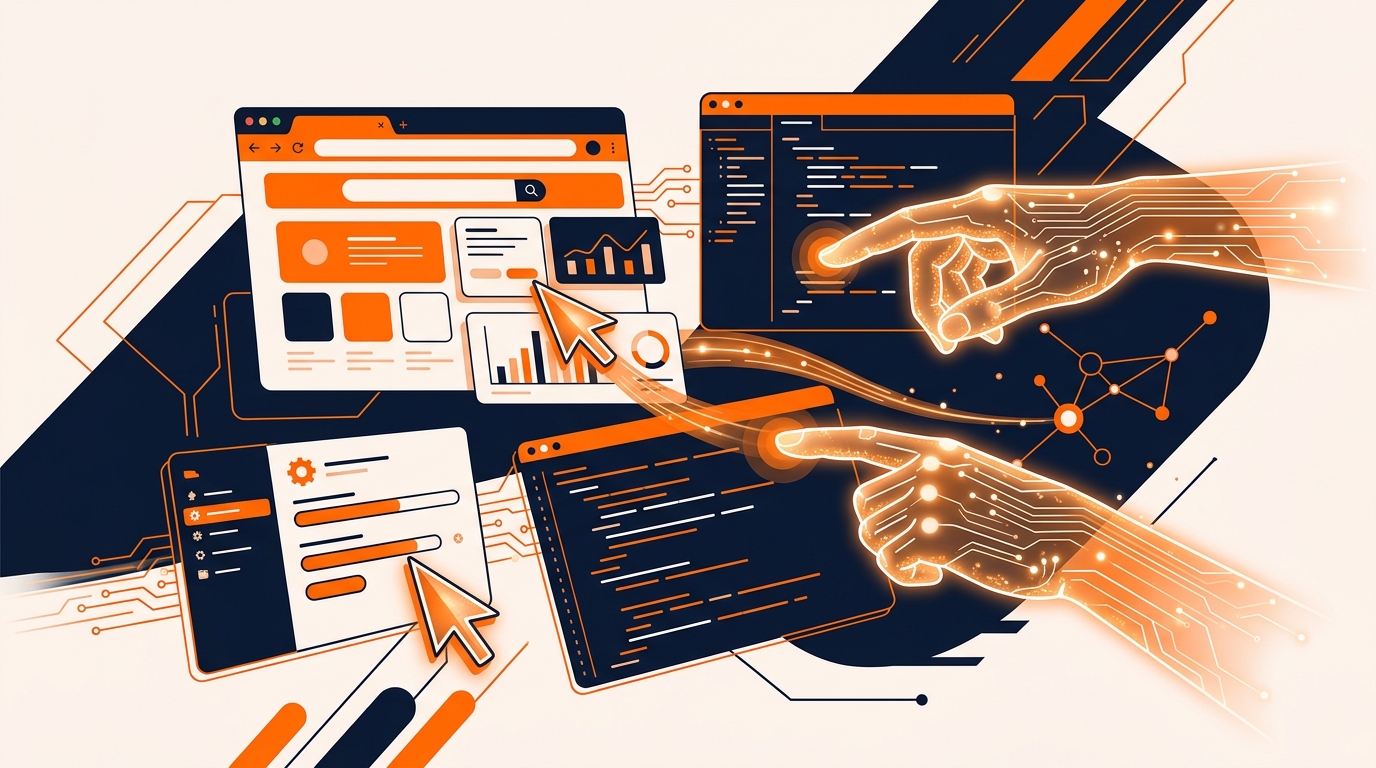
On March 5, 2026, OpenAI released GPT-5.4 — and for the first time in the history of AI benchmarks, a general-purpose language model has surpassed humans at the task of using a computer. On OSWorld-Verified, the industry's leading benchmark for desktop computer operation, GPT-5.4 scored 75.0% — beating the established human baseline of 72.4%, and more than doubling GPT-5.2's score of 47.3% on the same test. That is not a marginal improvement. It is a threshold crossing.
GPT-5.4 is also the first OpenAI model to unify frontier reasoning, state-of-the-art coding ability, and native agentic computer-use into a single system — eliminating the need to route tasks between specialized models. For developers building AI agents, for enterprises deploying AI automation, and for professionals thinking about what AI will do to their work over the next 18 months, GPT-5.4 is the most significant model release since GPT-4. Here is a complete breakdown of what it is, what it can do, and what it means.
What "Agentic Computer Use" Actually Means
The term "agentic computer use" has been circulating in AI circles since Anthropic introduced computer-use capabilities for Claude in late 2024. But GPT-5.4 represents the first time a general-purpose frontier model has made this capability a native, first-class feature — and the first time performance has exceeded what a human user can achieve on a standardized benchmark.
Here is what computer use means in practice:
- GPT-5.4 can open and operate applications — launching software, navigating menus, configuring settings — without human guidance for each step
- It can navigate web browsers autonomously — loading URLs, clicking links, filling forms, extracting information, and navigating multi-page workflows
- It executes complex multi-step workflows across applications — moving data between tools, running multi-application processes end-to-end
- It interprets screenshots and generates precise mouse and keyboard commands based on what it sees on screen
- It can write and execute code using Playwright and similar libraries to automate browser and desktop interactions programmatically
In other words: GPT-5.4 can look at a computer screen the way a human looks at one, understand what it is seeing, and take action to accomplish a goal — navigating through software interfaces, completing tasks, and adapting to unexpected states along the way.
The OSWorld-Verified benchmark is the gold standard for measuring this. It presents AI systems with realistic computer tasks — navigating software, filling forms, running searches, managing files — and scores performance against human-established baselines. GPT-5.4's 75.0% score surpassing the 72.4% human baseline is the first time any general-purpose model has crossed that line.
The Unified Model: Coding, Reasoning, and Computer-Use in One System
One of the structurally significant things about GPT-5.4 is what it eliminates as much as what it adds.
Previous OpenAI model releases forced developers and enterprises to route tasks between specialized models: GPT-5.3-Codex for coding-heavy tasks, GPT-5.2 for reasoning workloads, and (until now) no general model with competitive computer-use capabilities. Each handoff between models added latency, complexity, and coordination overhead. GPT-5.4 absorbs all three capabilities into a single system.
GPT-5.4 integrates GPT-5.3-Codex's coding prowess — making it OpenAI's strongest model for code generation, debugging, and automated software engineering — while also adding the enhanced reasoning and computer-use capabilities that make it competitive across a much wider range of agentic tasks.
The benchmark performance reflects this unification: - 75.0% on OSWorld-Verified — first general-purpose model to exceed human baseline (72.4%) - 83% on GDPval — performance comparable to professionals across 44 occupations - 33% reduction in the likelihood of individual claims being false compared to GPT-5.2 - 18% reduction in error rate across full responses
These numbers represent a model that is now genuinely useful — not impressive-but-unreliable — for high-stakes professional tasks across a wide range of domains.
The 1 Million Token Context Window
GPT-5.4's 1 million token context window (922K input, 128K output) in its API and Codex versions is the largest OpenAI has ever offered, and it matters significantly for agentic use cases.
To understand why, consider what a context window is in an agentic setting. Each time an AI agent takes a step in a multi-step task — browsing a page, taking a screenshot, running a command, reading a result — that step adds to the context the model is tracking. Long tasks produce long contexts. For complex agentic workflows — researching a topic across dozens of web pages, debugging a large codebase, or managing a multi-step enterprise process — the ability to hold an enormous amount of context without truncation or loss of coherence is a fundamental capability requirement.
A 1 million token context window can hold approximately 750,000 words — roughly the equivalent of the entire Lord of the Rings trilogy, or a medium-sized codebase, within a single model call. For multi-step computer-use agents, this means GPT-5.4 can maintain awareness of an entire task trajectory — every page it has visited, every action it has taken, every result it has received — without losing the thread.
A 272K context window is also available for use cases that do not require the full 1M capacity, representing a meaningful increase over GPT-5.2's capabilities.
Configurable Reasoning and the "Upfront Thinking Plan"
GPT-5.4 introduces two features that address a long-standing criticism of frontier AI models in professional settings: the lack of transparency and control over how the model approaches a problem.
Configurable reasoning effort allows developers to specify how much compute the model should spend on internal reasoning before generating a response. For straightforward tasks, lighter reasoning reduces latency and cost. For complex multi-step tasks or high-stakes decisions, deeper reasoning produces more reliable outputs. This trade-off is now explicitly configurable rather than opaque.
GPT-5.4 Thinking — available to ChatGPT Plus, Team, and Pro users — introduces an "upfront thinking plan" feature that surfaces the model's approach to a problem before generating the full response. Users can review the model's plan, adjust it if needed, and only then proceed to the full output. This is a meaningful change in how professionals can interact with frontier AI: rather than receiving a completed response and discovering mid-way through that the model misunderstood the task, users can catch and correct misalignments at the planning stage.
For enterprise workflows where accuracy and auditability matter — legal research, financial analysis, medical documentation — the ability to review and adjust the model's reasoning plan before committing to a full output is a significant improvement in practical reliability.
GPT-5.4 also introduces a new Tool Search capability within its API and Codex versions that significantly reduces token costs for tool-calling workflows, making it meaningfully more economical to build and scale agentic applications.
What GPT-5.4 Means for Professionals and Businesses Right Now
GPT-5.4 is not an incremental upgrade. It represents the first time a general-purpose AI system can credibly operate a computer — navigating software interfaces, completing multi-step workflows, and interacting with existing enterprise tools — with performance that exceeds what an average human user achieves on standardized tests.
For developers and technical teams, GPT-5.4 is worth evaluating immediately for: - Automated software testing and QA using computer-use capabilities - Multi-step research and data gathering pipelines - Code generation, review, and debugging workflows (inheriting Codex-class performance) - Building AI agents that operate existing enterprise software without requiring custom API integrations
For business leaders and operators, GPT-5.4 changes the calculus for which workflows are automatable. Any task that involves navigating existing software interfaces — filling forms, copying data between systems, running searches, generating reports within existing tools — is now a candidate for AI agent automation in a way it was not six months ago. The barrier is not technical capability any more. It is knowing which processes to prioritize, how to structure agent deployment, and how to manage human-AI collaboration at the workflow level.
For professionals in every field, the 83% performance on GDPval — competitive with professionals across 44 occupations — should be read not as a threat but as a signal: the professional fluency ceiling for AI is the professional ceiling for what AI can do without supervision. Understanding what GPT-5.4 can and cannot do reliably is now a foundational professional competency.
If you want to develop that competency — not as a passive observer but as someone who can direct, evaluate, and build with these tools — FireStart's Applied AI & Automation Program is the structured path. Join for free to explore our Guides library with Ember AI, or enroll in Cohort 3 for live instruction, hands-on projects, and applied AI certification.
Want to learn more about AI?
Join InLoop free — explore guides, connect with creators, and drop into live voice rooms.