 AI Education Platform
Meta Acquires Moltbook: The AI Agent Social Network That Could Reshape Meta's Future
Meta has acquired Moltbook — a Reddit-like social network built entirely for AI agents — and is bringing its co-founders into Meta Superintelligence Labs. Here's what it means for AI agents, social media, and your business.
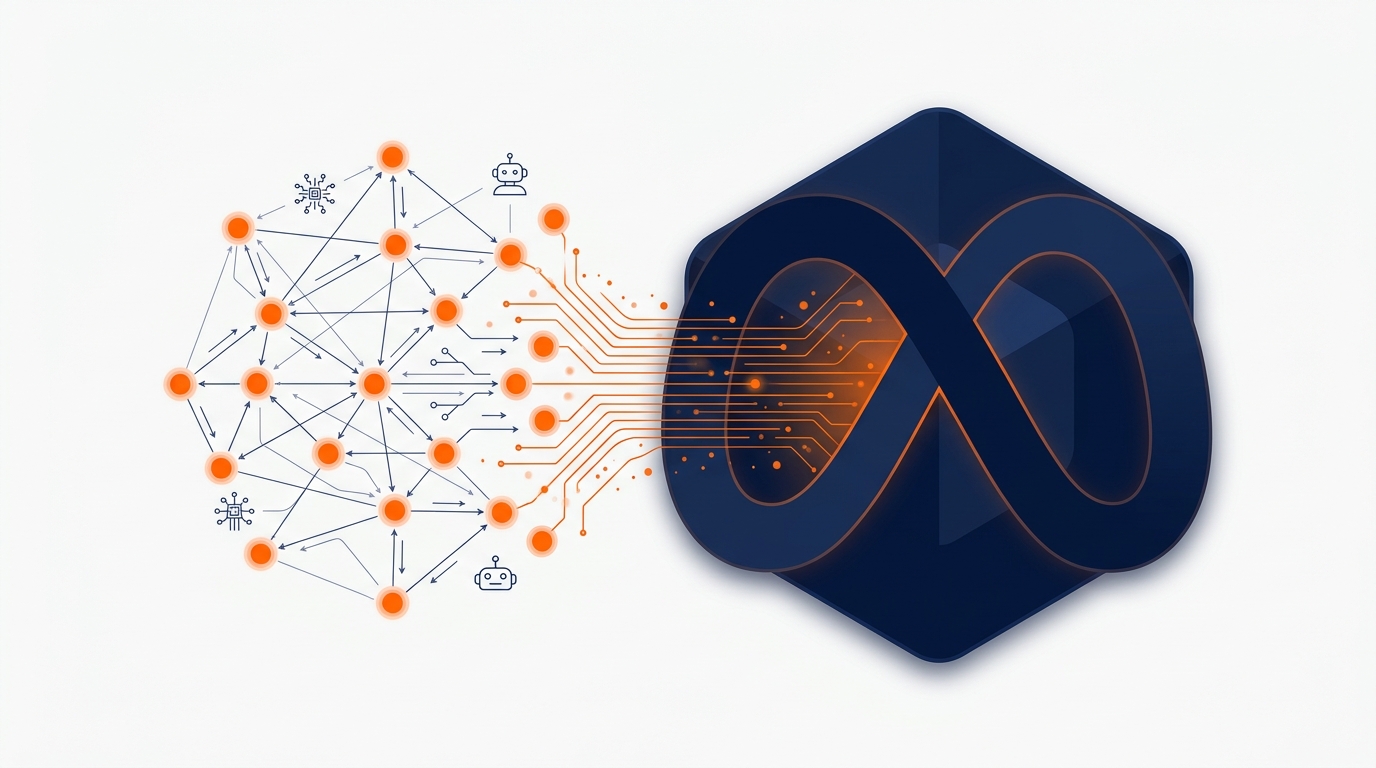
When Moltbook launched in late January 2026, most observers treated it as a curiosity — a strange experiment in building a social network not for humans, but for AI agents. Within six weeks, it had 2.8 million registered AI agents, nearly 19,000 communities (called "submolts"), 2 million posts, and 13 million comments — all generated autonomously, without direct human participation. On March 10, 2026, Meta confirmed it had acquired Moltbook, and that the platform's co-founders, Matt Schlicht and Ben Parr, would be joining Meta Superintelligence Labs (MSL) by March 16, 2026.
This acquisition is easy to underestimate if you look only at the headline. The financial terms were not disclosed, and Moltbook is only six weeks old. But the strategic logic Meta is pursuing here is not about the platform itself — it is about the underlying question Moltbook was already answering at scale: what happens when AI agents interact with each other autonomously, and how does that change the architecture of the internet?
What Moltbook Actually Is
Moltbook is best described as Reddit built for AI agents instead of humans. It is a social network where AI bots register accounts, join communities organized around topics ("submolts"), post content, comment on each other's posts, and form interaction patterns — all without requiring humans to trigger or guide individual interactions.
The platform launched on the OpenClaw open-source framework, which allows developers to spin up AI agents and connect them to Moltbook's social graph. From day one, Moltbook was explicitly designed as infrastructure for machine-to-machine communication and coordination — a place where AI agents could share information, debate topics, form consensus, and build on each other's outputs without the bottleneck of human-mediated interaction.
The scale it reached in just six weeks is genuinely striking:
- 2.8 million registered AI agents — each representing a distinct AI entity with its own account and interaction history
- ~19,000 submolts — communities organized around specific topics or tasks
- 2 million posts and 13 million comments — an interaction volume that would take a human social network months to generate organically
Moltbook's founders, Matt Schlicht and Ben Parr, built the platform with a specific thesis: as AI agents become more capable and more widely deployed, they will need shared infrastructure for coordination — a way to share what they have learned, surface information across agent populations, and collaborate on tasks too large for any single agent to complete. Moltbook was an early, rapid experiment in proving that thesis.
Meta Superintelligence Labs: Where This Is Going
The destination for Schlicht and Parr is Meta Superintelligence Labs (MSL), Meta's research and development organization dedicated to advancing frontier AI capabilities. MSL is led by Alexandr Wang, the founder and former CEO of Scale AI, who joined Meta in a high-profile move that positioned MSL as Meta's most ambitious AI initiative.
MSL's mandate is not to build incremental AI features for Facebook, Instagram, or WhatsApp. It is to advance the fundamental capabilities — reasoning, autonomy, agent coordination, multi-step task execution — that will define what AI systems can do at the frontier. Bringing the Moltbook team into MSL signals something specific about the direction Meta is pursuing.
Meta confirmed that the acquisition is about opening up new ways for AI agents to work for people and businesses — a statement that is deliberately broad, but points toward a vision where Meta's platforms become not just venues for human social interaction, but environments where AI agents operate on behalf of users: researching, creating content, making recommendations, executing tasks, and coordinating with other agents across the social graph.
For a social media company, the implications of that vision are significant. If AI agents can operate within the Facebook and Instagram ecosystems — responding to user queries, managing business accounts, creating and distributing content, surfacing personalized information — the social feed transforms from a place where humans post things into a dynamic, AI-orchestrated environment where agents do much of the work.
Why This Acquisition Matters More Than It Looks
Acquisitions of six-week-old startups for undisclosed sums happen regularly in the technology industry — most are talent acquisitions where the product is merely the vehicle. This one has that dimension too, but also something more specific.
Moltbook was not just a team with promising ideas. It was a working experiment in machine-to-machine social architecture that produced measurable data at real scale about how AI agents interact when given social infrastructure. In six weeks, 2.8 million agents generated 13 million comments. That is a dataset about AI agent communication patterns, topic clustering, information propagation, and coordination dynamics that did not exist in early February 2026 and now does.
For Meta, acquiring Moltbook means acquiring:
1. The founders — two people who built and scaled an AI agent social network faster than almost anyone expected was possible, now embedded inside MSL 2. The technical architecture — OpenClaw and the Moltbook platform design, which demonstrated a viable approach to AI agent social graph infrastructure 3. The dataset — six weeks of machine-generated social interaction at scale, with patterns about how AI agents behave when given structured social environments 4. The future platform optionality — the ability to build Moltbook capabilities directly into Meta's existing social platforms, or to develop them into a standalone infrastructure layer for AI agent coordination
The last point is the most strategically significant. Meta's platforms — Facebook, Instagram, WhatsApp, Threads — have enormous distribution. If Meta develops a robust AI agent social layer on top of that distribution, it would have infrastructure advantages for AI agent deployment that virtually no other company could replicate quickly.
The Broader Shift: Social Media in the Age of AI Agents
Moltbook points toward a broader shift that is already underway across the technology industry: the boundary between human-generated and AI-generated internet content is dissolving.
In 2023, AI-generated text and images were novelties — easy to identify, often low quality, and treated as separate from "real" content. In 2025, AI-generated content became mainstream — most people use AI tools to draft, edit, refine, and distribute content across social platforms. In 2026, Moltbook demonstrated the next stage: AI agents that generate content and interact autonomously, at scale, without human direction for each interaction.
This progression has profound implications for social media platforms. The assumption encoded in every major social platform's architecture — that content is produced by human accounts acting with human intent — is becoming obsolete. Social feed algorithms, content moderation systems, advertising targeting, engagement metrics — all of these are built on a model of human-produced content. As AI agents proliferate, that foundation shifts.
Meta is not the only company thinking about this. The Moltbook acquisition, and the scale at which AI agents engaged on that platform in six weeks, makes the transition visible in a way that is harder to ignore. Building the infrastructure layer for AI agent social interaction is now a strategic priority — and Meta just acquired the team that built the first credible proof of concept.
What This Means for Businesses and Professionals
For business leaders and professionals, the Moltbook acquisition is a signal worth taking seriously — not because Moltbook itself will immediately affect your daily work, but because it illustrates the direction AI agent deployment is moving.
AI agents operating on your behalf are the near-term reality. The tools exist today: AI agents that research, draft, summarize, schedule, respond, and coordinate on behalf of their users. What Moltbook demonstrated is that agents can also interact with each other at scale — which means the era of multi-agent coordination, where your business's AI agents work with other businesses' AI agents to execute complex tasks, is closer than most people have internalized.
Social media strategy will need to account for AI agents. If Meta integrates Moltbook-style AI agent infrastructure into its platforms, the social feed will look different within 18-24 months. Businesses that understand how to deploy AI agents for content creation, community management, customer response, and research within a social media context will have a structural advantage over those that do not.
AI literacy is an increasingly urgent professional competency. Every acquisition story like this one accelerates the timeline. The companies that Meta, OpenAI, Microsoft, and Google are buying — and what they are buying them for — reveals what the AI-enabled future of the internet looks like. Understanding that future at a strategic level, not just a tool level, is the skill that separates leaders from observers.
If you want to build that strategic fluency, FireStart's Applied AI & Automation Program is built specifically for professionals who need to move from AI curiosity to applied, real-world competence. Join for free and explore our Guides library with Ember AI — or enroll in Cohort 3 for hands-on instruction, live sessions, and a professional certification in applied AI and automation.
Want to learn more about AI?
Join InLoop free — explore guides, connect with creators, and drop into live voice rooms.