 AI Education Platform
Best AI Platforms for Vibe Coding Websites in 2026
Discover the best AI platforms for vibe coding websites in 2026. Build stunning sites with natural language, AI-powered editors, and zero traditional coding experience.
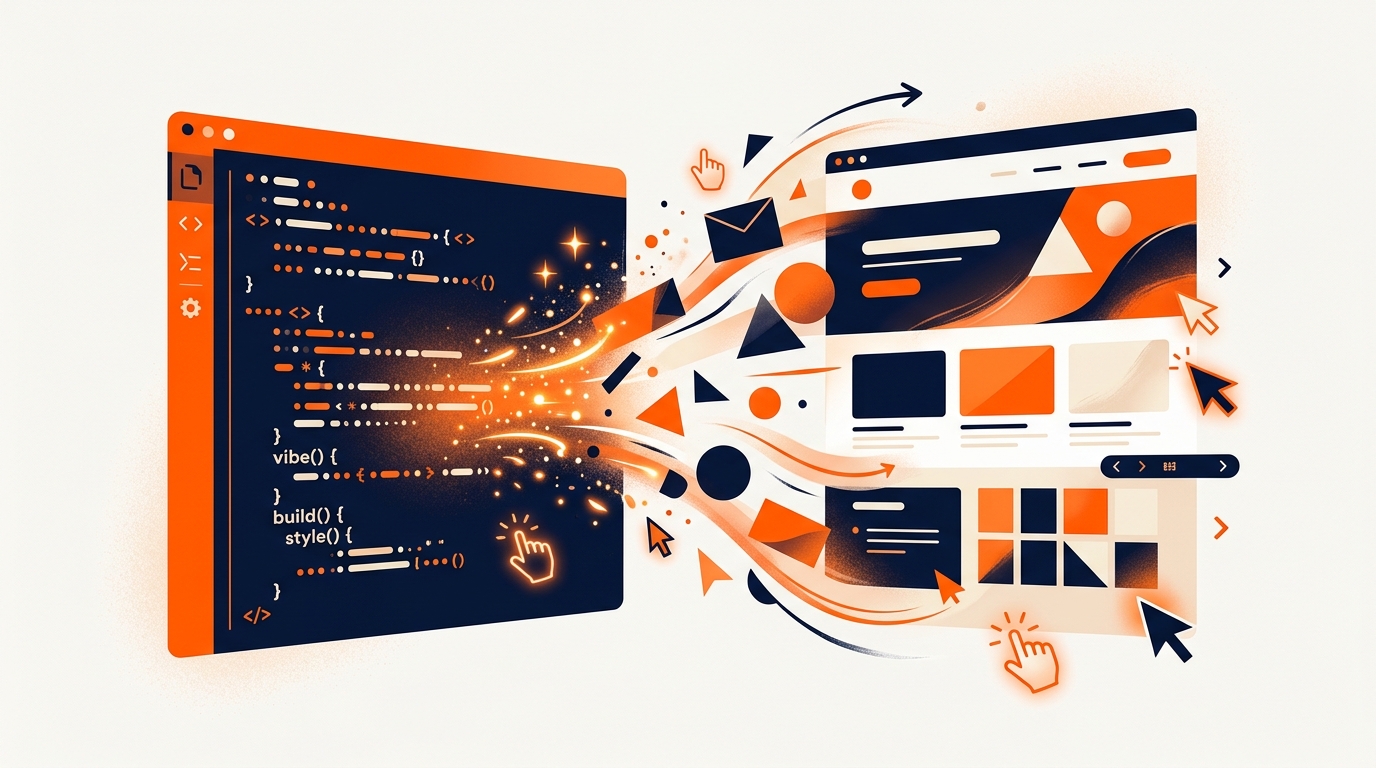
Something shifted in web development around 2025. A new phrase entered the tech lexicon: vibe coding. Coined by OpenAI co-founder Andrej Karpathy, vibe coding describes a way of building software where you describe what you want in plain English — and let AI write the code. You're not debugging syntax or memorizing APIs. You're directing, iterating, and shipping. And the websites that come out the other side? Often excellent.
The movement has exploded. Founders are launching startups without engineers. Designers are shipping interactive prototypes that go live. Marketers are spinning up landing pages in hours, not weeks. If you're curious about the broader shift in how AI is enabling people to work, our post on the best way to learn AI in 2026 covers the full landscape. But this post is specifically about the best AI platforms for vibe coding websites — the tools that actually let you build real, polished sites through conversation and iteration rather than traditional code.
What Is Vibe Coding, Exactly?
Vibe coding isn't a specific tool — it's a development philosophy. Instead of writing code line-by-line, you describe the outcome you want ("make this button animate on hover and match the orange brand color") and an AI agent translates that into working code. You review, refine with more natural language, and ship.
The term was popularized by Andrej Karpathy on X (formerly Twitter) in early 2025, and it spread fast. The key insight: you don't need to understand every line of code if you understand *what you're trying to build* and have an AI that can bridge the gap.
This is especially powerful for: - Landing pages and marketing sites - Portfolio sites and personal brands - Simple web apps and dashboards - Rapid prototyping and MVP launches - Non-developers who have clear product vision but limited coding background
1. Bolt.new (StackBlitz)
Bolt.new is arguably the most impressive vibe coding platform available right now. It's a browser-based AI development environment that lets you describe a full web application — and watch it appear in real time. No setup. No local dev environment. Just a prompt and a result.
What makes Bolt stand out is how far it goes. You're not just generating static HTML — it scaffolds entire React or Next.js applications, handles routing, connects APIs, and lets you deploy directly to Netlify or similar platforms. The iteration loop is remarkably fast: describe a change, see it applied, describe another.
Best for: Founders and makers who want to go from idea to deployed web app in hours. It handles surprisingly complex functionality.
Pricing: Free tier with usage limits. Paid plans from ~$20/mo for higher token allowances.
Limitation: Large projects can run into context limits, and the AI occasionally needs guidance to stay on track across many iterations.
2. Lovable.dev
Lovable.dev (formerly GPT Engineer) is purpose-built for vibe coding full-stack web apps. Describe your app, and Lovable generates a complete codebase — frontend, backend logic, database structure — and keeps it in sync as you iterate with natural language.
One of Lovable's defining features is its GitHub integration: every change is committed to a real repository, so you own your code and can hand it off to a developer at any point. It also integrates directly with Supabase for backend services, making it genuinely capable of building real products.
Best for: Entrepreneurs and non-technical founders who want a real, deployable product — not just a mockup — without hiring a developer at the start.
Pricing: Free tier. Pro from $20/mo. Team plans available.
Limitation: Works best when you have a clear product vision upfront. Ambiguous prompts lead to more revisions.
3. Cursor (with Claude or GPT-4o)
Cursor is the choice for people who want the full power of an AI code editor rather than a purely prompt-driven experience. Built on VS Code, it lets you chat with your codebase, accept multi-file edits, and generate entire features through conversation — while still giving you direct code access when you need it.
For vibe coding websites, Cursor is particularly powerful when paired with a modern framework like Next.js or Astro. You can describe a component ("add a hero section with an animated gradient background and a CTA button"), and Cursor will generate, place, and integrate it — often with minimal cleanup.
Best for: People who are comfortable looking at code even if they don't write it from scratch, and who want the most capable AI coding assistant on the market.
Pricing: Free tier (limited). Pro from $20/mo.
Limitation: Steeper learning curve than pure no-code vibe tools. You'll work inside an IDE, not a visual builder.
4. Replit (with Replit Agent)
Replit has evolved into a powerful vibe coding platform with the introduction of Replit Agent — an AI that can scaffold, build, and deploy web applications from a natural language description directly in the browser.
What sets Replit apart is its integrated environment: you get a code editor, live preview, database, and deployment in one place. Replit Agent handles the full build from prompt to production. It's particularly good for interactive web apps, tools, and games.
Best for: Beginners and students who want to build and ship real projects in a fully managed environment without dealing with local setup, servers, or deployment pipelines.
Pricing: Free tier. Core from $25/mo needed for Agent features and more compute.
Limitation: The AI Agent is powerful but can take time on complex builds. Free tier has limited deployments and compute.
5. v0 by Vercel
v0.dev is Vercel's generative UI tool — and it's brilliant for one specific use case: building beautiful, production-ready React UI components from a description. You describe a component ("a pricing table with three tiers, a dark background, and a glowing highlighted middle card"), and v0 outputs clean, copy-pasteable React + Tailwind code.
Unlike Bolt or Lovable, v0 doesn't build entire apps — it's a component generator. But for vibe coders building in Next.js or React, it's an incredible accelerator. Drop v0-generated components into Cursor, and you have a powerful combo.
Best for: Designers and developers who want pixel-perfect, modern React UI components without writing every line. Best in combination with Bolt or Cursor.
Pricing: Free with limited monthly credits. Pro from $20/mo.
Limitation: Component-focused, not a full app builder. You'll need another tool or framework to assemble the full site.
6. Framer (AI Site Builder)
Framer is the design-first option for vibe coding. While primarily a design tool, Framer has integrated AI site generation that lets you describe a website and get back a fully designed, responsive, interactive site — ready to publish on a custom domain.
For marketing sites, landing pages, and portfolio sites, Framer's output quality is exceptional. The animations, layout, and polish are on par with what a professional design agency would produce. And because it's visually editable, non-developers can refine the output through a drag-and-drop interface.
Best for: Marketers, designers, and anyone who wants a visually stunning marketing or portfolio site without writing any code.
Pricing: Free to design. Site hosting from $5/mo for basic. Pro plans from $25/mo.
Limitation: Less powerful for complex web applications with dynamic data. Best for marketing/content sites rather than full-stack apps.
7. Webflow (with AI Features)
Webflow has long been the gold standard for no-code website building, and its AI features are increasingly making it a vibe coding destination. AI layout generation and component suggestions let you move faster with natural language inputs feeding into the visual editor.
Webflow's superpower is its CMS capabilities — dynamic content, blog systems, e-commerce — built without code. For businesses that need a serious web presence with content management, Webflow remains the most powerful no-code-to-production option.
Best for: Businesses and agencies that need production-grade websites with CMS, e-commerce, or complex layouts — with full design control.
Pricing: From $14/mo (basic). Business plans from $39/mo. E-commerce plans from $29/mo.
Limitation: Steeper learning curve than most vibe coding tools. AI features are helpful but not as fully AI-driven as Bolt or Lovable.
Which Platform Is Right for You?
The best AI platform for vibe coding depends entirely on what you're building and how comfortable you are engaging with code:
- Building a full web app from scratch? → Bolt.new or Lovable.dev
- Want design-quality marketing or portfolio site? → Framer
- Building with React/Next.js and want AI assistance? → Cursor + v0
- Learning to code and want a managed environment? → Replit
- Need CMS + e-commerce power with design control? → Webflow
The common thread across all of these platforms: iteration is the skill. Vibe coding doesn't collapse the design process — it collapses the *translation* step between idea and running code. The more clearly you can describe what you want, and the faster you can evaluate and refine the output, the better the results.
This is why AI literacy matters so much. Understanding what AI can and can't do makes you a dramatically better director of these tools. If you want to build that foundation, sign up for a free FireStart account and explore our Guides library with Ember AI, our contextual AI tutor. The future belongs to people who can speak both human and AI fluently — and today, that means anyone who's willing to learn.
Want to learn more about AI?
Join InLoop free — explore guides, connect with creators, and drop into live voice rooms.